That YouTube Short seems to be a valid one. It’s by someone who (according to his own words) has a PhD in atmospheric physics. Basically, he says that contrails causes global warming by preventing heat from escaping from Earth, and that contrails are mostly only formed when a plane flies through a cold humid patch. By simply re-routing planes around these cold patches, the contrails could be reduced.
By simply re-routing planes around these cold patches, the contrails could be reduced.
And routes now are generally chosen to be the most fuel-efficient, subject to regulatory constraints such as avoiding overflight of areas of high population density. So any alternate path will be longer and burn more fuel.
According to this one study [1] that focused on Japanese airspace, 2.2% of the flights causes 80% of all contrail energy forcing (EF).
A small-scale strategy of selectively diverting 1.7% of the fleet could reduce the contrail EF by up to 59.3% [52.4, 65.6%], with only a 0.014% [0.010, 0.017%] increase in total fuel consumption and CO2 emissions. A low-risk strategy of diverting flights only if there is no fuel penalty, thereby avoiding additional long-lived CO2 emissions, would reduce contrail EF by 20.0% [17.4, 23.0%].
The re-routing can simply be achieved by changing the flight elevation by 2000 feet one or the other direction.
[1] Teoh, Roger et al. “Mitigating the Climate Forcing of Aircraft Contrails by Small-Scale Diversions and Technology Adoption.” Environmental science & technology vol. 54,5 (2020): 2941-2950. doi:10.1021/acs.est.9b05608
My legit question is then, is the impact on the average temperature by reducing the visible trails greater or less than the impact of adding the emissions from the extra fuel spent.
My gut tells me no, those number seem small, but small numbers often lie, and impacts to the chemical makeup of the atmosphere is an ongoing change whereas a trail of condensation is a short lived phenomenon.
This is not an argument either way, it seems like a legitimate question to me. It’s also not the question that “chemtrails” conspiracy theorists would ask.
Here’s a short answer: For a hundred-year time span, “diverting up to 1.7% of the flights could reduce the total EF by 35.6%. The reduction in total EF is contributed almost entirely by the reduction in contrail EF, while the change in the CO2 EF as a result of a diversion appears to be negligible.”
Long answer:
In that study, they created an algorithm that would divert flights vertically if they are going to create a large contrail, and if diversion is possible (the new airspace isn’t already in use). The algorithm chooses a flight path that has the best total energy forcing (EF). They then applied that algorithm for 6 one-week periods of recorded data. Those weeks were spread around the year.
From “Supporting Information” of that research report (the main text isn’t freely available):
To compare the climate forcing of contrails and CO2 emissions, the absolute global warming potential (AGWP), the time integral of the [radiative forcing] of CO2 over time, is used as a first-order approximation to quantify the CO2 EF and total EF (contrails plus CO2)
Although approximately 25% of the emitted CO2 remains in the atmosphere after a millennium, we applied the 100-year [time horizon] to be in line with the Kyoto Protocol, and assumed that the AGWP is normally distributed in the Monte Carlo simulation
For the six weeks of data, diverting up to 1.7% of the flights could reduce the total EF by 35.6% […]. The reduction in total EF is contributed almost entirely by the reduction in contrail EF, while the change in the CO2 EF as a result of a diversion appears to be negligible.
If an AGWP of a longer [time horizon] of 1000 years […] is used to quantify the EF of CO2, this sensitivity analysis suggest that the overall reduction in the total EF will be significantly smaller at 12.2% […]. In contrast, the total EF could be reduced by up to 50.1% […] if a shorter [time horizon] of 20-years […] is used.
While the potential changes in the global mean surface temperature, quantified using the Absolute Global Temperature Potential (AGTP) are also important, we have refrained from quantifying it because the current level of scientific understanding remains low.
Even when considering a thousand-year time span, diverting the flights still has a positive effect. And we can always play with the idea that mankind figures out a way to remove CO2 from the atmosphere, which would make those numbers for shorter time spans more meaningful.
That’s great info, thanks for the reply, seriously. It’s why I ask the questions and give you my reasons for them.
The part about the chemtrail types is because I have heard all kinds of arguments against them for tinfoil hat reasons. I’m very grateful to get some actual science.
According to him, the contrails have very potent effect on global warming. Apparently, contrails from just one year’s flights has almost the same effect as all the CO2 emitted by all flights ever. Re-routing extends the flight by only so much, so the added CO2 emission has negligible effect.
I’m not saying this is wrong because I don’t know shit but when ships crossing the Atlantic were forced to switch to low sulfur fuel a few years ago the North Atlantic rose in temp a few degrees. Turned out the sulfur in the exhaust was causes clouds to form in the atmosphere and was shading the ocean and masking global warming in that region. Pretty much the opposite effect of what you’re saying this dude is claiming.
Speaking with my limited knowledge, there apparently are cooling contrails and warming contrails, but the warming ones are more common. I don’t know why or when the contrails are cooling or warming.


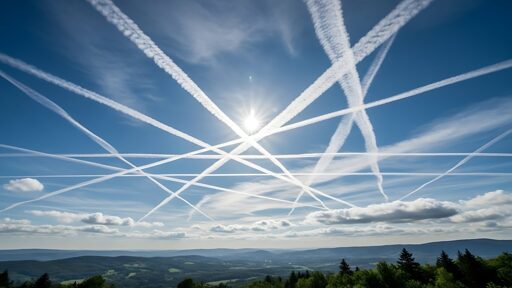
That YouTube Short seems to be a valid one. It’s by someone who (according to his own words) has a PhD in atmospheric physics. Basically, he says that contrails causes global warming by preventing heat from escaping from Earth, and that contrails are mostly only formed when a plane flies through a cold humid patch. By simply re-routing planes around these cold patches, the contrails could be reduced.
And routes now are generally chosen to be the most fuel-efficient, subject to regulatory constraints such as avoiding overflight of areas of high population density. So any alternate path will be longer and burn more fuel.
According to this one study [1] that focused on Japanese airspace, 2.2% of the flights causes 80% of all contrail energy forcing (EF).
The re-routing can simply be achieved by changing the flight elevation by 2000 feet one or the other direction.
[1] Teoh, Roger et al. “Mitigating the Climate Forcing of Aircraft Contrails by Small-Scale Diversions and Technology Adoption.” Environmental science & technology vol. 54,5 (2020): 2941-2950. doi:10.1021/acs.est.9b05608
My legit question is then, is the impact on the average temperature by reducing the visible trails greater or less than the impact of adding the emissions from the extra fuel spent.
My gut tells me no, those number seem small, but small numbers often lie, and impacts to the chemical makeup of the atmosphere is an ongoing change whereas a trail of condensation is a short lived phenomenon.
This is not an argument either way, it seems like a legitimate question to me. It’s also not the question that “chemtrails” conspiracy theorists would ask.
Here’s a short answer: For a hundred-year time span, “diverting up to 1.7% of the flights could reduce the total EF by 35.6%. The reduction in total EF is contributed almost entirely by the reduction in contrail EF, while the change in the CO2 EF as a result of a diversion appears to be negligible.”
Long answer:
In that study, they created an algorithm that would divert flights vertically if they are going to create a large contrail, and if diversion is possible (the new airspace isn’t already in use). The algorithm chooses a flight path that has the best total energy forcing (EF). They then applied that algorithm for 6 one-week periods of recorded data. Those weeks were spread around the year.
From “Supporting Information” of that research report (the main text isn’t freely available):
Even when considering a thousand-year time span, diverting the flights still has a positive effect. And we can always play with the idea that mankind figures out a way to remove CO2 from the atmosphere, which would make those numbers for shorter time spans more meaningful.
That’s great info, thanks for the reply, seriously. It’s why I ask the questions and give you my reasons for them.
The part about the chemtrail types is because I have heard all kinds of arguments against them for tinfoil hat reasons. I’m very grateful to get some actual science.
Wouldn’t rerouting be more fuel-intensive in most scenarios, though? I feel like burning more fuel to make fewer clouds isn’t the right play.
It would require a slight increase in fuel consumption, traded off with a large decrease in heating caused by the water vapour.
Seriously, you should watch the video, it covers all of this stuff.
According to him, the contrails have very potent effect on global warming. Apparently, contrails from just one year’s flights has almost the same effect as all the CO2 emitted by all flights ever. Re-routing extends the flight by only so much, so the added CO2 emission has negligible effect.
Good luck with the Florida and California flights.
I’m not saying this is wrong because I don’t know shit but when ships crossing the Atlantic were forced to switch to low sulfur fuel a few years ago the North Atlantic rose in temp a few degrees. Turned out the sulfur in the exhaust was causes clouds to form in the atmosphere and was shading the ocean and masking global warming in that region. Pretty much the opposite effect of what you’re saying this dude is claiming.
Speaking with my limited knowledge, there apparently are cooling contrails and warming contrails, but the warming ones are more common. I don’t know why or when the contrails are cooling or warming.