My legit question is then, is the impact on the average temperature by reducing the visible trails greater or less than the impact of adding the emissions from the extra fuel spent.
My gut tells me no, those number seem small, but small numbers often lie, and impacts to the chemical makeup of the atmosphere is an ongoing change whereas a trail of condensation is a short lived phenomenon.
This is not an argument either way, it seems like a legitimate question to me. It’s also not the question that “chemtrails” conspiracy theorists would ask.
Here’s a short answer: For a hundred-year time span, “diverting up to 1.7% of the flights could reduce the total EF by 35.6%. The reduction in total EF is contributed almost entirely by the reduction in contrail EF, while the change in the CO2 EF as a result of a diversion appears to be negligible.”
Long answer:
In that study, they created an algorithm that would divert flights vertically if they are going to create a large contrail, and if diversion is possible (the new airspace isn’t already in use). The algorithm chooses a flight path that has the best total energy forcing (EF). They then applied that algorithm for 6 one-week periods of recorded data. Those weeks were spread around the year.
From “Supporting Information” of that research report (the main text isn’t freely available):
To compare the climate forcing of contrails and CO2 emissions, the absolute global warming potential (AGWP), the time integral of the [radiative forcing] of CO2 over time, is used as a first-order approximation to quantify the CO2 EF and total EF (contrails plus CO2)
Although approximately 25% of the emitted CO2 remains in the atmosphere after a millennium, we applied the 100-year [time horizon] to be in line with the Kyoto Protocol, and assumed that the AGWP is normally distributed in the Monte Carlo simulation
For the six weeks of data, diverting up to 1.7% of the flights could reduce the total EF by 35.6% […]. The reduction in total EF is contributed almost entirely by the reduction in contrail EF, while the change in the CO2 EF as a result of a diversion appears to be negligible.
If an AGWP of a longer [time horizon] of 1000 years […] is used to quantify the EF of CO2, this sensitivity analysis suggest that the overall reduction in the total EF will be significantly smaller at 12.2% […]. In contrast, the total EF could be reduced by up to 50.1% […] if a shorter [time horizon] of 20-years […] is used.
While the potential changes in the global mean surface temperature, quantified using the Absolute Global Temperature Potential (AGTP) are also important, we have refrained from quantifying it because the current level of scientific understanding remains low.
Even when considering a thousand-year time span, diverting the flights still has a positive effect. And we can always play with the idea that mankind figures out a way to remove CO2 from the atmosphere, which would make those numbers for shorter time spans more meaningful.
That’s great info, thanks for the reply, seriously. It’s why I ask the questions and give you my reasons for them.
The part about the chemtrail types is because I have heard all kinds of arguments against them for tinfoil hat reasons. I’m very grateful to get some actual science.


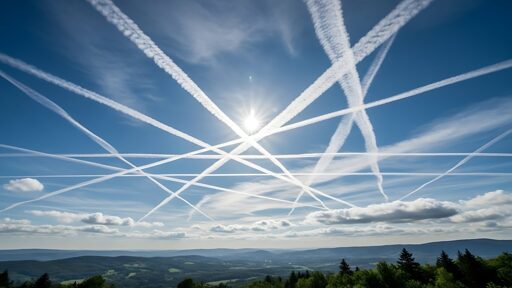
My legit question is then, is the impact on the average temperature by reducing the visible trails greater or less than the impact of adding the emissions from the extra fuel spent.
My gut tells me no, those number seem small, but small numbers often lie, and impacts to the chemical makeup of the atmosphere is an ongoing change whereas a trail of condensation is a short lived phenomenon.
This is not an argument either way, it seems like a legitimate question to me. It’s also not the question that “chemtrails” conspiracy theorists would ask.
Here’s a short answer: For a hundred-year time span, “diverting up to 1.7% of the flights could reduce the total EF by 35.6%. The reduction in total EF is contributed almost entirely by the reduction in contrail EF, while the change in the CO2 EF as a result of a diversion appears to be negligible.”
Long answer:
In that study, they created an algorithm that would divert flights vertically if they are going to create a large contrail, and if diversion is possible (the new airspace isn’t already in use). The algorithm chooses a flight path that has the best total energy forcing (EF). They then applied that algorithm for 6 one-week periods of recorded data. Those weeks were spread around the year.
From “Supporting Information” of that research report (the main text isn’t freely available):
Even when considering a thousand-year time span, diverting the flights still has a positive effect. And we can always play with the idea that mankind figures out a way to remove CO2 from the atmosphere, which would make those numbers for shorter time spans more meaningful.
That’s great info, thanks for the reply, seriously. It’s why I ask the questions and give you my reasons for them.
The part about the chemtrail types is because I have heard all kinds of arguments against them for tinfoil hat reasons. I’m very grateful to get some actual science.