99% companies have been using Windows for the past 30 years. I would gladly accept any job using Windows, even more if they paid well. I hate Windows way more than everyone else, but being unemployed is worse nowadays.
You assume they don’t already have a job and we’re just looking for other opportunities. Not everyone is unemployed before they apply for other jobs. If anything that is a good time to look as it gives you stronger position to negotiate from.
In the overwhelming majority of situations you cannot begin the onboarding process with IT while still working for a previous employer. Especially at this level of software engineering that would run afoul of moonlighting policies.
is what your describing technically possible? sure. Is it even remotely probable? Absolutely not.
If you begin the onboarding process as a senior backend engineer without inquiring as to what your working environment will be, then you’re just incompetent.
You are right. You cannot onboard a new job before you leave your old one. Accepting an offer is not part of the onboarding process though. It happens before.
After an interview process the company makes an offer. The candidate can then accept or reject it. But that is really all informal. You can then negotiate with them for an official start date and contract. You just need to ensure you can hand in your notice and work the rest of your notice period before the start date of your new contract.
I don’t know anyone that would hand in their notice before accepting the initial offer of a company. At least here in the UK.
Communicating with IT is absolutely part of the onboarding process. And the phrasing of the email clearly states they are rescinding an offer acceptance, as in they had already accepted and begun onboarding.
You are not considered to be working somewhere until you have signed a contract and after the start date on that contract. Accepting a offer is not signing a contract. You are not working at the new place yet. You have no obligations to do anything at that point. You just need to have stopped working at your current employment before your start date. You definitely do not need to quit before accepting the offer. No where I have worked requires that.
Yeah but a senior engineer would just use an old personal linux laptop from home, they wouldn’t even bother bitching about the employer issued machine.
Never, ever, EVER use your personal equipment for work.
There are a ton of legal reasons for that, not just around who owns the Copyright of work done on that machine as well as licensing of the software running in it (most commercial software has different licensing conditions for personal and commercial use) but also because if there’s some kind of legal case against that company your equipment might very well be confiscated as part of an investigation.
Also, more in general, if you have personal practices which are legally dubious or often frowned upon (piracy, porn) you don’t do it in the same machine where you’re doing your professional work, definitelly not on a work machine but even in your own machine it’s risky (see the point above about how your machine might end up confiscated and examined by the authorities if the company is investigated). The principle of “you don’t shit were you eat” applies here.
Even for your own company, it’s best to have the company stuff separate from personal stuff.
Beyond that, it’s also a very good idea in terms of having a good work-life balance to separate the personal from the professional: ideally you keep a very strong separation between work and not-work, at all levels, from work time and outside-work time to work/personal machine and work/personal phone - it helps make clear both for yourself and, even more importantly, others, that there is no work outside work, which reduces the chances of management doing things like call you on weekends or evenings with questions and makes it easier for them to accept when they try it and you say “I’m not at work now, so I’ll pick this up first thing when I’m back at work” - the cleaner and harder the split the less room there is for the “barely in control, almost 100% reactive” kind of manager to sneak work stuff into your personal-time.
Clients will have intellectual rights on anything produced for them. Removal of that data from their systems and storing it elsewhere will be a violation.
Using your own equipment other than maybe your monitor, mouse, or keyboard will be a no go. I don’t know of any serious workplace that would let you do otherwise.
Even if you are a self employed contractor you will need to remote in to their virtual environment and work in that.
I haven’t found a company that enforces windows of everyone. Seems ridiculous. I would sign the contract then simply require a Mac because I don’t know how to use Windows. IT be dammed.
Smaller companies, maybe. But bigger companies will have a ‘Security and Compliance’ department which will force everyone to use a company-supported platform. It goes beyond OS too. Unapproved apps, even if you are allowed to install them, may not connect to company resources.
Managing centralized security and device management correctly on multiple OSes must be a nightmare. From EDRs to app and device provisioning.
You should do dev work in devcontainers anyway.
Not that it’s an excuse or that I’m happy with that, but I can totally understand why companies do that, and tbh I’d rather see a properly secured than have the option to run Linux.
But I’m biased, because I used to do Red Teamings, and the things I’ve seen…
Devcontainers work for Visual Studio Code when developers are more than happy to click their way through running builds and debugging problems. But, as someone whose workflow is optimized for the command-line, they can fuck off.
for a senior engineer position though? That seems counterproductive. I would expect it of one of the entry levels or non-it but forcing a windows ecosystem on a development or engineering sector screams red flag to me.
A senior engineer obviously needs (and knows how to handle) considerably more access to their workstation and company IT infrastructure than the average employee. On the other hand, I’ve occasionally read complaints from IT security types about engineers being way too eager to install sketchy stuff.
There’s some truth to those complaints. I might need to try out several libraries and tools to see what works best for a certain use case. Is that new one with 15 stars on Github actually safe? Are all of its dependencies? How many developers perform a task like that in a sandbox? How many of those perform a thorough audit before taking it out of the sandbox?
I recently quit a company that does. They hid that until after I accepted and started. I quit out of frustration after a couple weeks of having to listen the the fan all day due to their surveillance and telemetry running. They even disabled sleep mode, so you either had to leave that thing phoning home 24/7, or forcibly shut down every day. 10 minute boot time on a brand new laptop.
Clamshell mode. External monitor, lid closed. My issue was that I could not tell it to sleep when not in use, because their IT disabled sleep to ensure their corporate spyware was always running.
That’s the part I get, but what does having the corporate spyware running 24/7 accomplish? What kind of telemetry would they even get out of that other than ip/location, which isn’t all that interesting.
It can check if people are typing or using the mouse.
It’s also possible to use the camera of a notebook to track if a person is present and looking at the screen or not.
Any company using that shit is the kind that uses “bums of seats” rather than actual deliverables as a measure of performance, which means they’re also the kind of place were unpaid overtime is the norm and, if in dev, things like projects often ending up in a death march stage - such places are stupidly inneficient and badly managed with a disfunctional work culture.
Avoid such companies like the plague - you’ll be luck if the worst that happens is insane work hours.


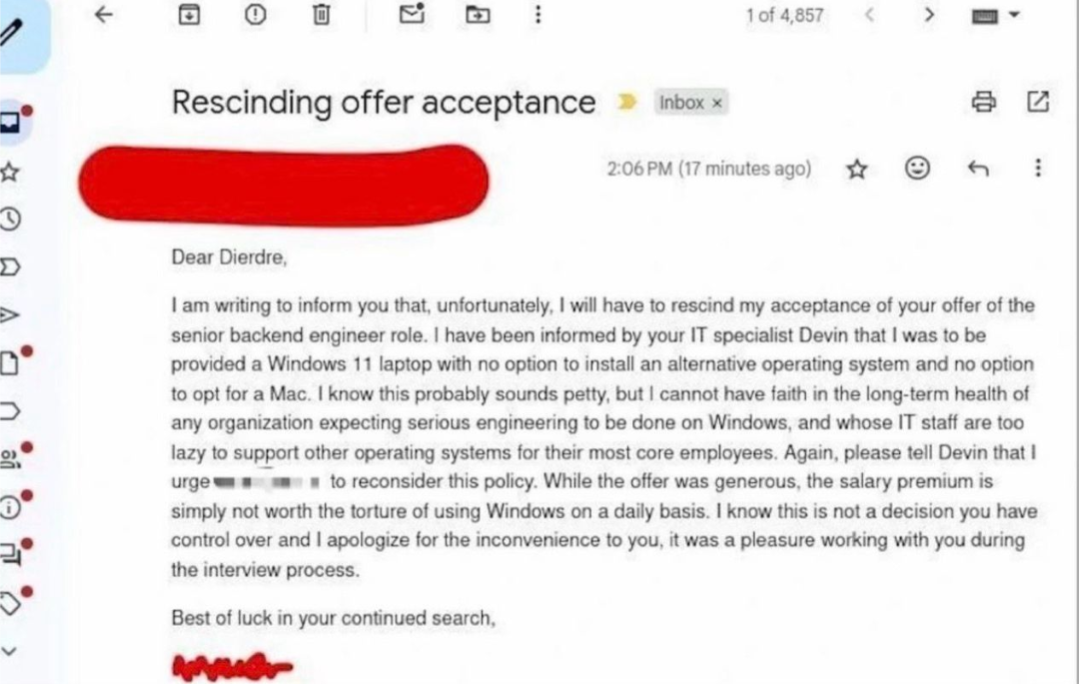
99% companies have been using Windows for the past 30 years. I would gladly accept any job using Windows, even more if they paid well. I hate Windows way more than everyone else, but being unemployed is worse nowadays.
You assume they don’t already have a job and we’re just looking for other opportunities. Not everyone is unemployed before they apply for other jobs. If anything that is a good time to look as it gives you stronger position to negotiate from.
In the overwhelming majority of situations you cannot begin the onboarding process with IT while still working for a previous employer. Especially at this level of software engineering that would run afoul of moonlighting policies.
is what your describing technically possible? sure. Is it even remotely probable? Absolutely not.
If you begin the onboarding process as a senior backend engineer without inquiring as to what your working environment will be, then you’re just incompetent.
You are right. You cannot onboard a new job before you leave your old one. Accepting an offer is not part of the onboarding process though. It happens before.
After an interview process the company makes an offer. The candidate can then accept or reject it. But that is really all informal. You can then negotiate with them for an official start date and contract. You just need to ensure you can hand in your notice and work the rest of your notice period before the start date of your new contract.
I don’t know anyone that would hand in their notice before accepting the initial offer of a company. At least here in the UK.
Communicating with IT is absolutely part of the onboarding process. And the phrasing of the email clearly states they are rescinding an offer acceptance, as in they had already accepted and begun onboarding.
You are not considered to be working somewhere until you have signed a contract and after the start date on that contract. Accepting a offer is not signing a contract. You are not working at the new place yet. You have no obligations to do anything at that point. You just need to have stopped working at your current employment before your start date. You definitely do not need to quit before accepting the offer. No where I have worked requires that.
They would quit working at the old company before they start work at the new one. usually there wouldn’t be overlap.
Is this some usa user who haven’t heard about other countries? (and I doubt it’s even true in the usa).
Not only is this definitely true in the US but I know it’s true in other countries like the UK and Japan as well.
Senior backend engineering definitely doesn’t see 99% windows adoption rate.
deleted by creator
Yeah but a senior engineer would just use an old personal linux laptop from home, they wouldn’t even bother bitching about the employer issued machine.
Never, ever, EVER use your personal equipment for work.
There are a ton of legal reasons for that, not just around who owns the Copyright of work done on that machine as well as licensing of the software running in it (most commercial software has different licensing conditions for personal and commercial use) but also because if there’s some kind of legal case against that company your equipment might very well be confiscated as part of an investigation.
Also, more in general, if you have personal practices which are legally dubious or often frowned upon (piracy, porn) you don’t do it in the same machine where you’re doing your professional work, definitelly not on a work machine but even in your own machine it’s risky (see the point above about how your machine might end up confiscated and examined by the authorities if the company is investigated). The principle of “you don’t shit were you eat” applies here.
Even for your own company, it’s best to have the company stuff separate from personal stuff.
Beyond that, it’s also a very good idea in terms of having a good work-life balance to separate the personal from the professional: ideally you keep a very strong separation between work and not-work, at all levels, from work time and outside-work time to work/personal machine and work/personal phone - it helps make clear both for yourself and, even more importantly, others, that there is no work outside work, which reduces the chances of management doing things like call you on weekends or evenings with questions and makes it easier for them to accept when they try it and you say “I’m not at work now, so I’ll pick this up first thing when I’m back at work” - the cleaner and harder the split the less room there is for the “barely in control, almost 100% reactive” kind of manager to sneak work stuff into your personal-time.
I mean yeah i wiped an old laptop and have that as a backup for work, don’t use it for anything else except when i don’t have the work laptop on me
Clients will have intellectual rights on anything produced for them. Removal of that data from their systems and storing it elsewhere will be a violation.
Using your own equipment other than maybe your monitor, mouse, or keyboard will be a no go. I don’t know of any serious workplace that would let you do otherwise.
Even if you are a self employed contractor you will need to remote in to their virtual environment and work in that.
Okay so remote in then idk how you accept a job and them giving you a windows laptop is a deal breaker
How are they going to use a personal device when corporate policy locks that down?
They don’t use a personal laptop, and I’ve never heard of such thing for any company that has more than 10 employees. The security risk is huge
I haven’t found a company that enforces windows of everyone. Seems ridiculous. I would sign the contract then simply require a Mac because I don’t know how to use Windows. IT be dammed.
Smaller companies, maybe. But bigger companies will have a ‘Security and Compliance’ department which will force everyone to use a company-supported platform. It goes beyond OS too. Unapproved apps, even if you are allowed to install them, may not connect to company resources.
Managing centralized security and device management correctly on multiple OSes must be a nightmare. From EDRs to app and device provisioning.
You should do dev work in devcontainers anyway.
Not that it’s an excuse or that I’m happy with that, but I can totally understand why companies do that, and tbh I’d rather see a properly secured than have the option to run Linux.
But I’m biased, because I used to do Red Teamings, and the things I’ve seen…
Devcontainers work for Visual Studio Code when developers are more than happy to click their way through running builds and debugging problems. But, as someone whose workflow is optimized for the command-line, they can fuck off.
for a senior engineer position though? That seems counterproductive. I would expect it of one of the entry levels or non-it but forcing a windows ecosystem on a development or engineering sector screams red flag to me.
A senior engineer obviously needs (and knows how to handle) considerably more access to their workstation and company IT infrastructure than the average employee. On the other hand, I’ve occasionally read complaints from IT security types about engineers being way too eager to install sketchy stuff.
There’s some truth to those complaints. I might need to try out several libraries and tools to see what works best for a certain use case. Is that new one with 15 stars on Github actually safe? Are all of its dependencies? How many developers perform a task like that in a sandbox? How many of those perform a thorough audit before taking it out of the sandbox?
Yeah but MacOS has all the same security and group policy controls as windows.
Yeah but managing it fucking sucks.
I recently quit a company that does. They hid that until after I accepted and started. I quit out of frustration after a couple weeks of having to listen the the fan all day due to their surveillance and telemetry running. They even disabled sleep mode, so you either had to leave that thing phoning home 24/7, or forcibly shut down every day. 10 minute boot time on a brand new laptop.
Can you explain this disabling sleep mode thing? What does having the thing awake while it’s closed even accomplish?
Clamshell mode. External monitor, lid closed. My issue was that I could not tell it to sleep when not in use, because their IT disabled sleep to ensure their corporate spyware was always running.
That’s the part I get, but what does having the corporate spyware running 24/7 accomplish? What kind of telemetry would they even get out of that other than ip/location, which isn’t all that interesting.
It can check if people are typing or using the mouse.
It’s also possible to use the camera of a notebook to track if a person is present and looking at the screen or not.
Any company using that shit is the kind that uses “bums of seats” rather than actual deliverables as a measure of performance, which means they’re also the kind of place were unpaid overtime is the norm and, if in dev, things like projects often ending up in a death march stage - such places are stupidly inneficient and badly managed with a disfunctional work culture.
Avoid such companies like the plague - you’ll be luck if the worst that happens is insane work hours.