
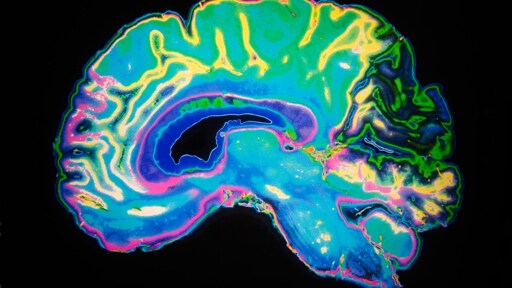
The news was presented at the AAAS meeting in Phoenix, Arizona. Anna Fowler presented a synthesis of dozens of studies on near-death experiences and neuroelectrical activity around cardiac arrest. - https://particle.news/story/aaas-presentation-argues-consciousness-may-persist-minutes-to-hours-after-clinical-death
@kalkulat@lemmy.world @science@lemmy.world
This reminds me of the time I had general anesthesia during a surgery. I experienced this… phenomenon. One where I barely closed my eyes and, suddenly, I was laid down on another bed in another room, surgery was complete. There was no dreaming in-between, no hallucination, and even the “time gap” itself felt… non-existent. Just a literal, overwhelming but relaxing, almost cosmic, “nothingness”. As if the general anesthesia were a Seek-Forward button which was pushed and my biological existence simply jumped an unknown amount of time into the future (it was roughly an hour, a simple surgery).
See, the passage of time looks pretty much like a “fall” towards a singularity. All matter is moving towards a point into the “far future”, some moving slower than others due to the gravitational and relativistic effects (e.g. time is slightly slower for us than it is for ISS astronauts, because we’re closer to the Earth’s gravitational well). There are scientific hypotheses about the “far future” having some kind of “singularity”, such as the logical conclusion from the Black Hole Cosmology which states that this universe were actually a cosmically-big black hole due to how cosmological constants and measurements matched the ones expected for black holes. If this proceeds, matter would be literally falling towards a cosmic “abyss”, towards singularity, and what we, as living beings, perceive as “death”, would be just the subjective (almost “solipsistic”) stretched perception of said singularity.
At least, I myself like to think of my death as this. A spaghettified but imperceptible, fall towards the abyss, akin to that general anesthesia I once had, except that it wouldn’t jump to wakefulness anymore; rather, it would become stuck in a perpetual state of “Seek-Forward”, without a perceivable gap in-between. An eternal nothingness, essentially a return to the same “nothingness” I perceive from the time before I was born. And, well, it’s scary, but it’s also pretty comfortable if I really think about that, knowing that there’d be no more nociceptors triggering my central nervous system into feeling pain, knowing that there’d be no more emergent “me”, just the primordial “nothingness” from the singularity we, as baryonic matter, exist in.
I got some (dark, esoteric) beliefs alongside that (especially “Death Herself”) but, given I’m in c/science, I’m trying my best to stick to the more (or, at least, as close as) scientific (as) aspects (could get) of what I think about the phenomenon of death, with “sentience” as an emergent byproduct of a dynamic system (think “dual pendulum experiment”, but deeper and more intricate involving several interconnected biological systems) we refer to as biological organism, a self-rearranging structure, and “death” as the cessation of said emergence (as soon as the a significant part of this dynamic system grinds to a halt, therefore rendering it unable to self-rearrange).
Hmmfh, you might benefit from this. As time goes on (see what I did there) it seems like information is the actual zero point energy concept in quantum mechanics. The possibility that entropy can’t really destroy information, merely disperse it until an eventual reconciliation is pretty fascinating. Black holes might even be seen as stasis chambers. Perhaps we all emerge again at the big crunch (or the restaurant at the end of the universe) for the next go around.
Personally I remain an Agnostic until such time that I know better, I expectation manage with the switch just turns off, but I’m fine with something else, sometime else, patterns written into the void. If there is a hell however, I’m totally going Karen, that’s bullshit.
Thanks for a most excellent post.
@MalReynolds@slrpnk.net @science@lemmy.world
That’s… highly interesting, thanks for recommending it! I’ll be pondering on this reading.
As someone who believes in some kind of cyclical cosmos (Ordo ab Chao, Chao ab Ordine), it pretty much matches the way I try to make sense of it religiously, although I also believe (or, deep inside, I want to believe) there’s a chance that this cosmic cycle is able to grind to a halt somehow, due to how, scientifically speaking, decay is something observed for cyclical processes (e.g. in the water cycle, some water is always “lost” from the water cycle, not “lost” as matter stuff, but “lost” as recyclable water; similar thing happens for nitrogen cycle and carbon cycle and even the biological food web/transfer of energy from plants to herbivores to carnivores; even orbiting undergo decay as the orbiting cycles repeat; cycles aren’t 100% efficient because of an omnipresent decay) and this may apply for information as well (the transformation of information wouldn’t be 100% efficient and would be subjected to this decay). We shall think of decay not as “loss” (because it would violate Conservation of Energy), but as a branching and merging between parallel cycles going on (e.g. in a nutshell, the water lost from earthly water cycles becomes part of other cycles, such as sparse H2O molecules as vapor ending up escaping to outer space, never getting to precipitate as rain, and becoming eventually attracted by orbiting stuff such as falling towards asteroids or into the Moon, falling towards planets at vicinity, or falling towards to the Sun (less likely due to how it requires a higher delta-v), as chaotically as n-body orbits can get)
Then there’s a hypothesis “zero-sum universe” stating that the overall energy from the entire universe sums up to exactly zero, so the whole universe is also accounted when it comes to the laws of conservation of energy. If fluctuations decay as the cycles happen, this can still add up to zero, until everything is infinitesimally close to zero.
But, again, I’m highly speculating across several, seemingly unrelated concepts (which somehow “click” in my ND mind). In the end of the day, it’s something seemingly beyond what we, with scientific rigor, could empirically get to observe and prove.
What would be the consequence of death being the “stretched perception”, like are you saying that we wake up again after death because of black holes or…?
@QueenHawlSera@sh.itjust.works @science@lemmy.world
(Disclaimer: I’m being speculative while trying to connect scientific principles and hypotheses. I’m aware this is not strict science, even though I’m trying to keep my religious beliefs aside.)
Much to the opposite, akin to a PC which was powered off forever. The transition between “powered-on” and “forever powered-off” states is something unexpected to the “software” (the “sentience” emerged inside our brains). Living beings, especially those with nervous system like us, are wired to being alive, and death is unexpected and unknown state, so this “transition” (dying) is confusing. As all senses across the body become numb, adaptiveness plays a role, with the cortices trying to compensate for the lack of sensory input (including inputs from within the brain itself, as synapses begin to fail), including a heightened activity of long-term memory as it tries to remember what exactly led to this “dying” state (part of fight-or-flight response): there’s the Near-Death Experience ppl often recall experiencing after effectively dying but getting to be reanimated.
I believe there’s an extra-baryonic factor in play too (what spiritualists would call “spiritual realm” would be another “brane” from a multibrane cosmos, with everything having “spiritual matter”, not necessarily self-rearranging (“living”) and the so-called “soul” merely another emergent property of a physical structure made of “spiritual stuff”, akin to a baryonic sentience), but it’s belief so I’m keeping this out.
As the emergent properties within sentience are inexorably bounded to its “hardware” (i.e. the body and its nervous system), the way matter is constantly subjected to entropy is an intrinsic part of cognition (i.e. brain gets wired and accustomed to the effects of entropy, trying to adapt as the years pass and aging happens, just like (geologically) life adapted outside water during Late Devonian and (individually) astronauts aboard ISS become accustomed and develop muscle memory for microgravity motion).
This means, if Black Hole Cosmology is to be considered, that the effects of “existing inside a black hole” are indirect part of how life adapts (e.g. adapting to the way time “stretches” as the years pass). The energy within matter (chemical reactions that keep happening even after death, especially those from decomposition processes) means that the physical structure from which “sentience” emerged will be subjected to the entropy long after being rendered unable to self-rearrange as living being. The brain may’ve died, but its organic molecules are still undergoing reactions at the microscopic level, until being completely transformed by decomposition and eventually fossilized. As there’s no working memory registering mechanisms anymore, it’s essentially “undergoing time without registering it”, pretty much akin to the “time gap from general anesthesia”.
I concur