I would assume that was probably what is called pool fire. If you heat a candle enough, you can get its stearin to vaporize before it’s lit on fire. The vaporized stearin burns very hot, causing the rest of the stearin to vaporize even faster, meaning there will be more fire, etc.
That’s why you should never put many tealights next to each other. They can be very skilled in causing a pool fire. And looking at the photo of a lot of candles shoulder to shoulder to each other, one would assume from the photo that there will eventually be a pool fire. Especially since there’s a tent that can do a good job directing the oxygen flow.
Theoretically, all candles, practically, candles where the wax is held in some kind of container are more prone to this. Wax is technically a combustible liquid (it will only burn in its liquid state, and what actually burns, are its vapours). Due to the relatively high flash point of wax, it normally only burns with the aid of a wick. If you stack enough candles too close to each other, the wax can potentially heat up beyond its flash point, though, and start burning on its entire surface. Foreign objects falling into the molten wax, acting as an additional wick, can also increase the heat output of a candle’s flame, heating the wax beyond its flash point.
This phenomenon typically only happens with candles that are enclosed in some sort of container where the entire wax can and will melt. With stick type candles, the excess molten wax will usually run off, away from the flame heating it, and when all the wax is gone, the flame will go out. Unless you put them into some kind of relatively small container, where the wax can accumulate and the hat can’t get away. But you’d need some awfully small container with an awful lot of stick candles in order to achieve that.
The shape of the candle plays a role as well. In order to boil, material must first melt. Beeswax candles are made so narrow that no pool of molten beeswax can form. And without it being liquid first, it also cannot boil.
That’s just how it works with every wax candle, it’s the physics behind it. Beewax has an even lower melting point than Stearin, so it should happen the same if you put 20 candles next to each other.
The problem is that burning candles release heat. More candles close to each other -> more heat -> faster evaporation of the wax -> faster burning -> even more heat. But it’s not happening from 3 or 6 candles, we are talking 15 or even more.


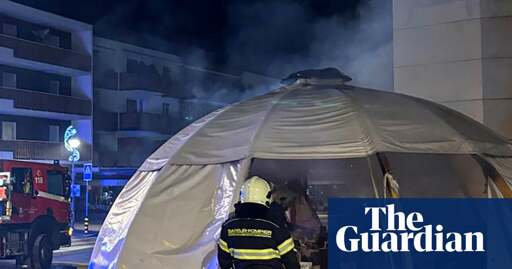
I would assume that was probably what is called pool fire. If you heat a candle enough, you can get its stearin to vaporize before it’s lit on fire. The vaporized stearin burns very hot, causing the rest of the stearin to vaporize even faster, meaning there will be more fire, etc.
That’s why you should never put many tealights next to each other. They can be very skilled in causing a pool fire. And looking at the photo of a lot of candles shoulder to shoulder to each other, one would assume from the photo that there will eventually be a pool fire. Especially since there’s a tent that can do a good job directing the oxygen flow.
What kind of candles are prone to this? Like, why make them out of that material at all? Beeswax candles don’t do that, as far as I know…
Theoretically, all candles, practically, candles where the wax is held in some kind of container are more prone to this. Wax is technically a combustible liquid (it will only burn in its liquid state, and what actually burns, are its vapours). Due to the relatively high flash point of wax, it normally only burns with the aid of a wick. If you stack enough candles too close to each other, the wax can potentially heat up beyond its flash point, though, and start burning on its entire surface. Foreign objects falling into the molten wax, acting as an additional wick, can also increase the heat output of a candle’s flame, heating the wax beyond its flash point.
This phenomenon typically only happens with candles that are enclosed in some sort of container where the entire wax can and will melt. With stick type candles, the excess molten wax will usually run off, away from the flame heating it, and when all the wax is gone, the flame will go out. Unless you put them into some kind of relatively small container, where the wax can accumulate and the hat can’t get away. But you’d need some awfully small container with an awful lot of stick candles in order to achieve that.
The table is able to function as such a container once the candles have burnt low enough, if there are ma y candles.
But you typically can’t pack such thick candles tightly enough to heat up all the wax beyond its flash point.
The shape of the candle plays a role as well. In order to boil, material must first melt. Beeswax candles are made so narrow that no pool of molten beeswax can form. And without it being liquid first, it also cannot boil.
That’s just how it works with every wax candle, it’s the physics behind it. Beewax has an even lower melting point than Stearin, so it should happen the same if you put 20 candles next to each other.
The problem is that burning candles release heat. More candles close to each other -> more heat -> faster evaporation of the wax -> faster burning -> even more heat. But it’s not happening from 3 or 6 candles, we are talking 15 or even more.