

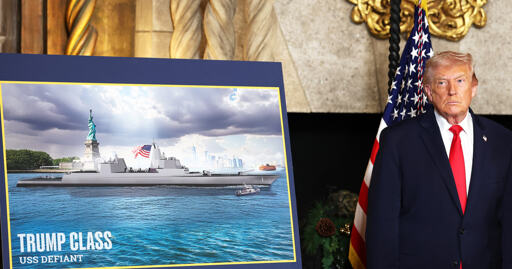
The move comes amid outcry from Democrats after the John F. Kennedy Center for the Performing Arts affixed Trump’s name to its sign in Washington.
Donald Trump’s name is being attached to a new class of U.S. battleships that will have nuclear capabilities.
Making the announcement at an event at Trump’s Mar-a-Lago estate in Florida, Navy Secretary John Phelan referred to the warships as “Trump-class battleships" and said a forthcoming vessel dubbed the USS Defiant will be “the largest, deadliest and most versatile and best-looking warship anywhere on the world’s oceans.”
Trump’s eponymous battleships will be armed with guns and missiles, as well as hypersonic weapons, electronic rail guns and high-powered lasers.
The issue with submersible drones is connection. Underwater only very low frequency can go through the water, reaching outside of the water. There are new technologies to improve it, but it’s very limited. So drones would need to operate autonomously. It’s possible, but detection and acquisition is hard, and based on known loggings in databases. And loggings do not exist for newer platforms, or if a platform received new screws for example. Semisubmersibles are a better option, they can be equipped with starlink for example. You can see their effective use already with Ukraine, fighting off the Russian black Sea fleet without a navy in their own. Fully submersibles are possible, but much more difficult to use effectively. The US already has them, but mainly for logging and registering the sound velocity (based on salinity and temp, on different depths) but not for engaging, or at least as far as we know so far.
Fiber optic cables solve that
This is used for launching torpedoes, they are called wire guided. Although they mostly use thin copper wire for that. But the seas are vast. It would mean you would need cables of hundreds of kilometers per drone, they will break under its own weight after a few hundred meters, if they are even able to reach that. Even if you only want to use them to defend your territorial waters, that’s 12nmi (22km) from your coastline.
Another option you might think off is a cable to the surface, but it will be dragged down when the drone moves. Warships usually move between 20 and 30 kts, carriers can go even faster. You need a drone capable of catching up but with these speeds there’s a significant amount of drag. The wire guided torpedoes have a copper wire spool so it doesn’t pull a wire though the water, but lays the wire behind it. If you want to have a drone with a massive fiber optic cable winch inside itself, the drones will get huge.
So when using cables, drones are kinda useless as it would only work short range and we already have torpedoes which are very effective at sinking ships. Only one is needed to sink a massive ship. It explodes under the ship, creating a massive amount of pressure, then a vacume, breaking any ship in half. As you can see here.
So current submersible drones are operating autonomously and are not remotely controlled. This is the best option imo, or like I said before: semisubmersibles. But engaging targets autonomously is a tricky thing. You don’t want it to accidentally hit the wrong one. But when you have an acoustic profile of your target, it’s definitely possible. There are already torpedoes with these capabilities, as well as missiles targeting radar profiles or locking on stored images. But like I said before, you need to have this information about your target. So in most cases a sub needs to have logged the ship while being close to it.