

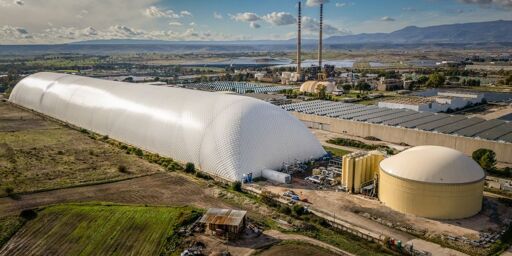
"This giant bubble on the island of Sardinia holds 2,000 tonnes of carbon dioxide. But the gas wasn’t captured from factory emissions, nor was it pulled from the air. It came from a gas supplier… “The facility compresses and expands CO2 daily in its closed system, turning a turbine that generates 200 megawatt-hours of electricity, or 20 MW over 10 hours.”
This CO2 is acting as a reusable fluid in a closed loop. The initial capture of the CO2 costs energy, but the battery keeps using the same CO2 over and over again. So the question of efficiency should be more about land usage and maintenance of the rest of the parts and the labor needed for each megawatt stored vs what other grid scale energy storage costs in materials and labor.
The rough reality is that batteries aren’t going to be up to the task of grid scale energy storage unless they have a couple huge breakthroughs. Something like this is a far less materially expensive way to store energy for later use.
Currently most grid scale energy storage is just pumping water up a hill and letting it back down through a generator. It is extremely limited in where it can be used and requires tremendous space to be effective.
Compressing gas generates heat, and a significant part of that heat will be lost. Heat dissipation is irreversible, and this lowers efficiency a lot.
BTW the same reason why in industry, pneumatic drives are universally replaced by electric motors: Their efficiency is too low.
There is a thermal energy storage included as s major part. This works because compressing CO2 to 55atm adiabatically heats it up to some 450-ish C, so that heat is pretty high grade, and only the final stage cools it down with heat exchanger open to air. In discharging direction, some heat is taken from outside air to evaporate part of CO2 and heat stored is used up
The number of decommissioned but still usable batteries are growing fast though, and plenty of storage sites use old battery packs, both from cars and home energy storage and stuff like it