

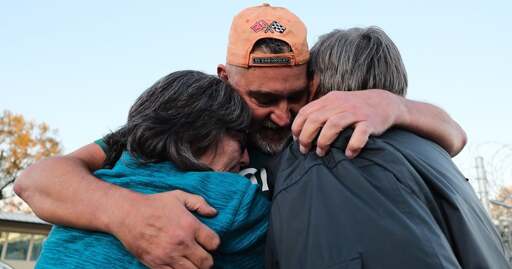
Jimmie “Chris” Duncan walked out of the Ouachita Parish Correctional Center and into the arms of his parents last week after spending the last 27 years on death row.
Seven months ago, a Louisiana district court judge vacated his murder conviction for killing his former girlfriend’s toddler, citing doubts about the evidence used to convict him. The judge granted bail after multiple legal delays, including an unsuccessful request by prosecutors to the Louisiana Supreme Court to stop his release. Now free, Duncan spent Thanksgiving with his family — then celebrated his 57th birthday the next day.
But Duncan’s journey to freedom is far from over. Prosecutors have asked the state Supreme Court to reinstate his death sentence. Duncan’s attorneys declined to make him immediately available for an interview.
The two justifiable cases for the death penalty
All Violent crimes committed by members of the military.
Prosecutors where an executed individual has been subsequently vindicated.
Both mandatory minimum sentences. That is all.
Treason.
That’s the one. If you fight your own country from within, that’s treason. Death by hanging.
not to get in the way of ur patriotic fervor, but what constitutes
fightinghereIn the broad sense.
so like voting for the other guy?
Look I am all about armed revolution, allegedly, so.
So, you would give the death penalty to a prosecutor who has sought justice but condemned an innocent man to death?
That seems somewhat reasonable, actually.
…But not someone who raped and drowned a 23-month-old girl in his care? Assuming he actually did that, of course.
I’ve always believed in death penalty for sex abuse of minors (and especially preteen/younger kids). I won’t debate it because I understand the arguments that capital punishment has no place in civilised society and all that.
You really dovetailed into the sex offences here.
We are talking about a man who was literally exonerated due to the primary evidence used for prosecution being absolute horseshit. The girl’s mother has also flat out said “he did not do that”.
Please remember that
This is one of the main points. Whenever the death penalty comes up, proponents like to use what I call the “ultimate evil”. They propose some criminal that’s guilty of all the worst things they can throw at it (rape, child rape, murder, torture, etc). Then ask rhetorically if that person should be put to death. It’s easy to defeat that argument by asking, “After that person is dead, it’s uncovered that they were innocent (like actually innocent, not some technicality or only guilty of a lesser crime like manslaughter) and the victim of some elaborate framing by a massively corrupt system. Are you still happy with the outcome?” I’ll be one of the first to say there are people in the world that deserve to die. I can name the certain acts too that I’m sure many would agree with and maybe some that less agree with. But then who carries out the act? And are you willing to put 100% trust in them that they get it right every single time?
Pretty much why I’m anti-death-penalty in all cases. The state shouldn’t be allowed to deal death as a punishment, because there’s too much at stake. You can’t un-kill someone if you get things wrong, and prosecutors have a vested interest in, at the very least, not being wrong. Being right doesn’t matter, but being wrong can cost you your position or your credibility within the legal field. Killing the defendant wraps things up nicely because a corpse can’t defend itself, and it can’t say “I wasn’t there” or “I had nothing to do with this”, it can’t plead its own innocence - so you can put whatever words you like into their mouths and it plays perfectly with a jury.
You reminded me of this wisdom from Gandalf: